
Optimisation of Storage in Film Production
In today’s film industry, the volume of data generated is simply immense. Ultra-high-resolution productions, advanced visual effects, and the need for quick access to large amounts of information have made storage a key component in the creative process.
In this digital era, film production faces one of its greatest challenges: the efficient management of massive data volumes. 8K, 4K recordings, cutting-edge VFX, and the high-speed access demanded for content have placed storage firmly in the spotlight. Far from being a mere technical component, choosing the right storage solution can make the difference between a seamless workflow or a production slowed by technological bottlenecks.
Currently, resolutions range from 2K to 8K:
- 2K (2048 x 1080 pixels): Though less common than before, some productions still use 2K for smaller projects or visual effects work, as it remains suitable for projection in many cinemas and comes with lower storage and processing costs.
-
4K (4096 x 2160 pixels): The standard resolution for most modern film productions, 4K offers excellent image quality, ideal for cinema and streaming platforms. Many film cameras, such as the ARRI Alexa, capture in 4K or a similar resolution.
-
6K (6144 x 3160 pixels): Used in productions seeking greater detail, 6K provides more flexibility in post-production for reframing or applying visual effects without quality loss. Cameras like the RED Dragon or Blackmagic URSA can record in 6K.
-
8K (8192 x 4320 pixels): Increasingly popular, especially in high-budget productions with complex visual effects. Cameras like the RED Helium and Sony Venice support 8K recording, which ensures exceptional quality for the most advanced cinema screens

In this context, traditional storage solutions, such as SSDs, hard drives (HDD), and LTO tapes, remain essential. However, with the rise of cloud storage and the need to balance performance, capacity, and cost, hybrid solutions have emerged as an ideal alternative. At Telefónica Servicios Audiovisuales (TSA), our expertise in broadcast systems integration has allowed us to become specialists in implementing customised hybrid solutions, optimising resources and enabling production companies to make the most of each technology.
In this article, we will explore the various recording and storage options and how hybrid solutions can drive efficiency and innovation in film production. Next, we will review the most commonly used storage solutions for cinema, as well as RAW and compressed recording formats.
Traditional Storage Solutions
For years, several technologies have dominated storage in film production, from SSDs and NVMe to HDDs and LTO tapes, each with advantages and disadvantages depending on the project stage.
Storage is typically handled via the DIT cart, a mobile station equipped with monitors, storage devices, camera card readers, hard drives, and computers. On this cart, the DIT is responsible for:
- Downloading and backing up video files
- Managing the colour workflow (initial on-set colour correction)
- Monitoring image quality and ensuring files are transferred correctly
For video file storage, high-speed portable SSD or HDD units are used for immediate on-set backups. Files can later be sent to centralised storage servers during post-production or even stored in the cloud for remote access, depending on workflow needs.
Types of Storage Used in Cinema
SSD and NVMe Storage
SSD and NVMe units are preferred for the editing and post-production stages of cinema due to their high read and write speeds, allowing the handling of 4K, 8K, and higher resolutions. Although extremely effective, their cost per gigabyte can be a limitation for productions with tight budgets.
Hard Drives (HDD)
Traditional hard drives offer large storage capacity at a more accessible price, making them ideal for storing large data volumes that do not require immediate access. However, their performance is lower than that of SSDs, which may slow down workflows that demand greater agility.
LTO Tapes for Long-Term Archiving
LTO tapes are the industry standard for long-term storage. They are economical, durable, and offer high capacity. Their main disadvantage is sequential access, which means longer retrieval times, making them less ideal for environments requiring immediacy.

*Image generated by AI
Film Recording Formats
Recording formats play a crucial role in the visual and narrative quality of a production. Since the early days of cinema, technological advancements have enabled filmmakers to capture images with greater precision, detail, and depth. Nowadays, digital formats have largely displaced celluloid, offering a variety of options in terms of resolution, compression, and image quality.
Film recording formats vary depending on factors such as resolution, dynamic range, and the type of camera used. From RAW formats that allow maximum flexibility in film post-production to compressed formats like ProRes or XAVC that balance quality and file size, each option has direct implications for storage requirements, workflows, and the final on-screen result.
Understanding the differences between these formats is essential for selecting the right option according to the type of production, as they not only affect the film’s aesthetics but also practical aspects such as file handling, editing times, and storage costs.
In film production, the choice of recording format depends largely on the camera used, the desired resolution, colour depth, and bitrate. Below are some of the most common formats and their storage requirements:
RAW (CinemaDNG, REDCODE, ARRI RAW)
- Cameras: ARRI Alexa, RED (Dragon, Helium), Blackmagic URSA.
- Resolutions: 4K, 6K, 8K.
- Bitrate: Depending on the RAW format and compression used, the bitrate can vary greatly. For example:
- Storage Space: One hour of recording in REDCODE 8K can occupy between 1.5 TB and 2.5 TB, while ARRI RAW at 4.5K takes up approximately 500-600 GB per hour.
ProRes (Apple ProRes 422, ProRes 4444)
- Cameras: Used by many cameras, including ARRI Alexa and Blackmagic.
- Resolutions: 4K, 6K.
- Bitrate:
- Storage Space: One hour of footage in ProRes 422 HQ at 4K can occupy 400 GB. ProRes 4444, in turn, may consume 600-700 GB per hour.
XAVC (Sony)
- Cameras: Sony F55, FS7.
- Resolutions: 4K.
- Bitrate:
- Storage Space: One hour of recording in XAVC-I at 4K takes up about 120 GB.
H.264 / H.265 (HEVC)
- Cameras: DSLR, mirrorless, and some cinema cameras like the Panasonic GH5.
- Resolutions: 4K, 6K.
- Bitrate:
- Storage Space: One hour of recording in H.264 at 4K could occupy 40-50 GB, while in H.265, it would be around 25 GB.
Impact on Storage
Depending on the resolution, format, and camera used, storage needs can vary significantly:
- 8K RAW (REDCODE 5:1) may require 2.5 TB per hour, demanding high-performance storage solutions such as SSD or NVMe during post-production.
- 4K ProRes 4444 consumes approximately 600 GB per hour, ideal for high-quality projects where smooth editing is crucial, although storage can be managed with high-capacity HDDs.
- XAVC-I and H.264 are more efficient, with much lower space consumption rates, allowing the use of hybrid or cloud storage for greater flexibility and scalability.
Specific Camera and Format Examples
- RED Helium 8K recording in REDCODE RAW generates around 300 MB/s, and a typical feature film production will require several petabytes of storage.
- ARRI Alexa LF using ARRI RAW at 4.5K generates between 120-150 MB/s, a preferred option for high-quality cinema.
- Sony FS7 with XAVC-I at 4K, with a bitrate of 240 Mbps, is ideal for documentaries or television productions with lower storage demands.
Storage Recommendation
Since storage needs vary by format and project stage, a hybrid solution may be ideal:
- SSD/NVMe for immediate editing in high resolution.
- HDD for general project storage, where accessibility is important but not critical.
- LTO tape for long-term archiving.
- Cloud for enabling remote collaboration and scalability.

Cloud Storage: Flexibility and Scalability
In recent years, cloud storage has gained ground due to its flexibility and scalability, allowing data access from anywhere and facilitating remote work and real-time collaboration.
At TSA, we promote the use of this technology, which represents a major opportunity to speed up and reduce the costs of productions. However, reliance on the cloud presents certain challenges, such as the need for robust connections and managing associated costs.
Hybrid Solutions: The Best of Both Worlds
Given these options, the question arises: is there a solution that combines the advantages of each storage option? The answer is yes. At TSA, we are leaders in integrating hybrid solutions for the broadcast sector, applying this approach also to film production. These solutions allow for the combination of fast storage (for immediate-access data), economical storage (for less critical data), and cloud storage (for flexibility and collaboration), achieving an optimal balance between speed, capacity, and cost.
Imagine a workflow that utilises high-speed SSDs from manufacturers like Samsung or Western Digital for editing, where speed is crucial. These are complemented by high-capacity HDDs from Seagate, Western Digital, or Toshiba for general project storage. For long-term archiving, LTO tapes from IBM or Quantum are used, ensuring cost-effective, durable preservation of finalised material.
Additionally, by integrating cloud services from providers like AWS, Oracle Cloud, Google Cloud, or Microsoft Azure, we facilitate remote access and collaboration among geographically dispersed teams. By incorporating an optimised Media Asset Management (MAM) system, we manage and preserve production archives efficiently. This implementation of broadcast workflows in cinema is proving to be beneficial, accelerating processes and reducing costs, supported by archiving and asset management technologies from specialised partners like TEDIAL.
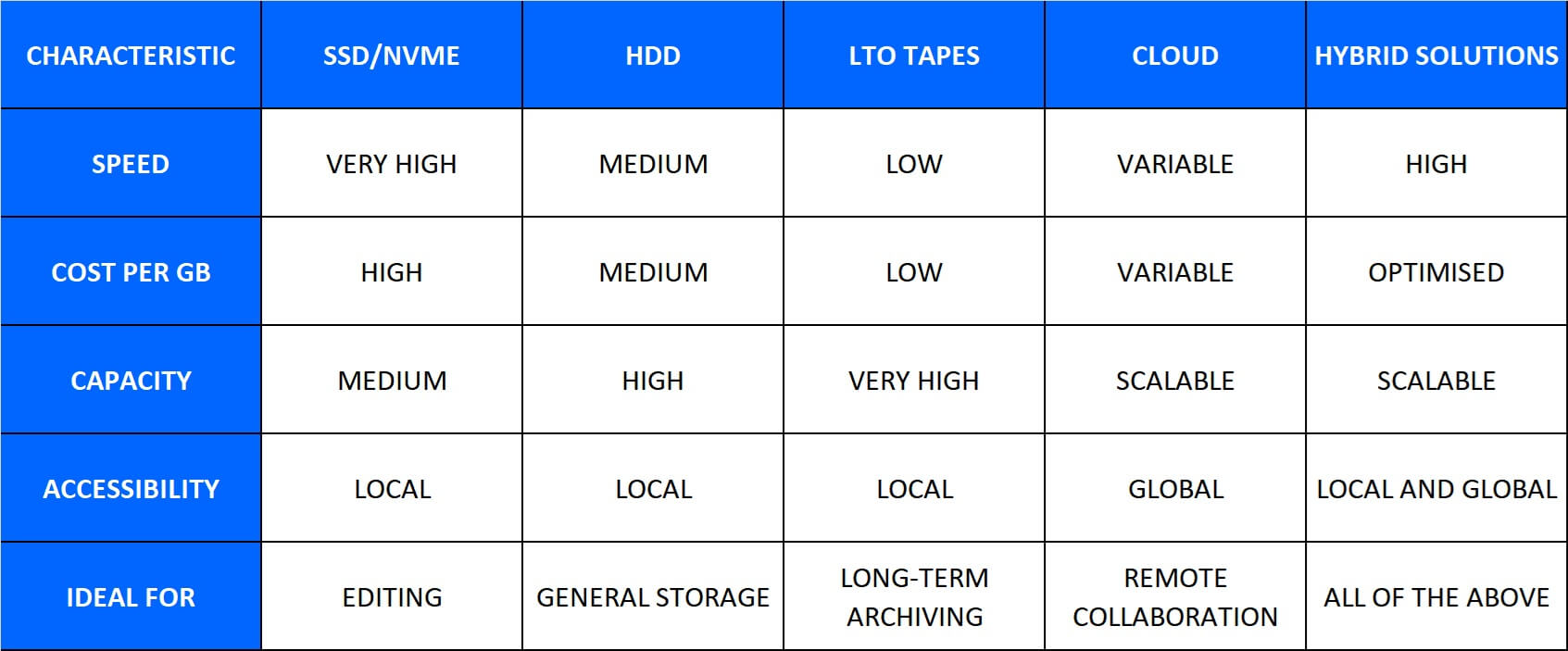
The choice of a storage system is key to balancing speed, capacity, cost, and accessibility. Hybrid solutions integrate the best of each technology, optimising resources to improve efficiency and accelerate workflows in audiovisual production.
In today’s film production environment, where image quality and workflow efficiency are paramount, choosing the right storage solution can make the difference between success and delays in a production. At TSA, we understand that each project has its own unique needs, and that is why we offer customised hybrid solutions that combine the best of each technology: speed, capacity, and accessibility.
Thanks to our experience in broadcast system integration and our constant commitment to technological innovation, we support film production companies at every stage of the process, ensuring that the most valuable data of a production is secure, accessible, and ready for any future challenge.
If you are looking to optimise your workflows, improve the efficiency of your film post-production, or implement a robust and scalable 4K storage solution, TSA can help transform your production. Contact us today to discover how our solutions can take your project to the next level.

Asier Anitua Valluerca
Business Development Manager
Telefónica Servicios Audiovisuales
